
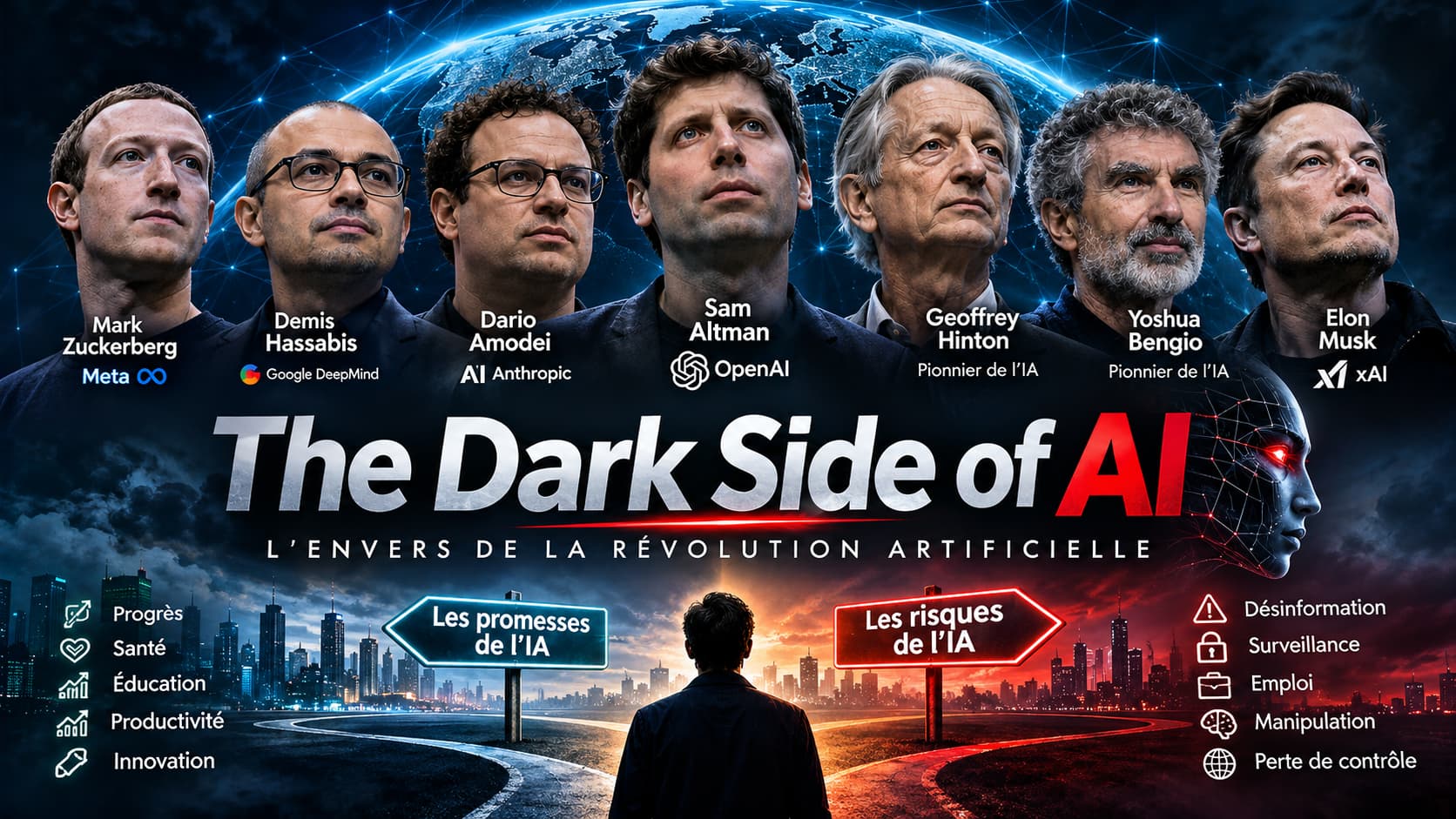
How this technology is already transforming our lives, what it can do, what it cannot do… and why understanding it has become essential.
Artificial intelligence is everywhere
Artificial intelligence is everywhere. It translates our messages, recommends films, recognizes faces, corrects our writing, supports certain medical decisions and now answers our questions in language that sounds remarkably like our own. It is becoming part of businesses, public administrations, universities, hospitals and even our everyday conversations.
Since the arrival of large generative AI tools, this presence has become far more visible. In a matter of seconds, a machine can write a letter, summarize a book, create an image, compose music or explain a complex subject. Sometimes all it takes is a question.
The ease of use is startling. The technology behind it is even more so.
Behind this apparent simplicity are highly complex computer systems, trained on enormous quantities of data and capable of performing tasks that, until recently, seemed to belong exclusively to human beings.
But do we really know what artificial intelligence is? How does it work? Does it learn in the way we do? Does it understand what it tells us? And, above all, what can we reasonably expect from it?
Before examining the promises, concerns and power struggles surrounding this revolution, we need to take a short detour. Not to deliver a computer science lesson, but to establish a few essential points of reference.
Because what lies ahead goes far beyond how a machine works.
An intelligence… but what kind?
The expression “artificial intelligence” can be misleading. It suggests that a machine has become intelligent in the same way as a human being. The reality is much more complicated.
Artificial intelligence, or AI, refers to a range of techniques that enable computer systems to perform tasks normally associated with certain human abilities: recognizing, classifying, learning, translating, forecasting, solving problems or generating content.
There is no single definition on which everyone agrees. The Organisation for Economic Co-operation and Development (OECD) updated its definition in November 2023. Under this definition, an AI system is a machine-based system that, for explicit or implicit objectives, infers from the input it receives how to generate outputs — such as predictions, content, recommendations or decisions — that can influence physical or virtual environments. Different systems may operate with varying levels of autonomy and adaptability after deployment.
Behind this definition lies a fairly simple idea: giving a machine the ability to process information, draw conclusions from it and produce an output without a human having to dictate every operation.
Take a familiar example. When your email service automatically places a message in the spam folder, it may rely on mechanisms capable of recognizing patterns shared by thousands of fraudulent messages. When your phone identifies your face, it analyses visual features to determine whether they match those it has been trained to recognize.
In both cases, the machine is performing a task that requires more than a simple calculation or a sequence of basic instructions.
This does not mean that it thinks as we do. It means that, through computational methods, it can reproduce certain operations associated with our intellectual abilities.
And that distinction is fundamental.
How can a machine learn?
To understand how many of today’s artificial intelligence systems work, it helps to remember three elements: data, algorithms and models.
Data is the raw material. It can take the form of texts, photographs, sounds, videos, figures or information collected by sensors.
Algorithms are mathematical and computational methods used to process that data.
A model, finally, is a system designed to perform a task. In machine learning, it is adjusted during a training process using data. Once trained, it can be used to analyse new information and produce an output.
Imagine that we want to teach a computer to recognize cats.
We show it thousands of photographs: black cats, white cats, ginger cats, sitting, lying down, facing the camera or seen from the side. During training, the system identifies patterns in the images: shapes, textures, proportions and combinations of features.
It is not necessarily given a complete list of rules such as: “a cat has two pointed ears, whiskers and a tail.” It learns from the examples it is shown.
Once trained, the model can be given a photograph it has never seen before and estimate whether it contains a cat.
This is the general principle of machine learning.
There are several ways in which a system can learn. In supervised learning, examples are accompanied by expected answers. In unsupervised learning, the system looks for groupings or structures in data without receiving the same prior guidance. In reinforcement learning, it improves by trying out actions and receiving rewards or penalties according to the results.
These methods are not interchangeable, but they share a common aim: enabling a machine to identify patterns from experience rather than relying exclusively on instructions written in advance.
From the human brain to artificial neural networks
Another expression comes up frequently in discussions about artificial intelligence: neural networks.
The name is no accident. These mathematical systems are inspired, in a highly simplified way, by certain features of how the human brain works.
In our brains, neurons communicate through complex connections. Artificial neural networks reproduce some principles of information processing through computational units connected to one another and arranged in layers.
During training, the system gradually adjusts a large number of mathematical parameters in order to reduce the difference between its outputs and the expected results, according to the method being used.
When these networks contain many layers, the approach is known as deep learning.
This approach has greatly expanded the possibilities of artificial intelligence. It has contributed, in particular, to advances in speech recognition, image analysis, machine translation and language processing.
But the analogy has limits: an artificial neural network is not a miniature brain. It does not have our biological organization, our experience of the world or, necessarily, our forms of understanding.
The vocabulary borrowed from neuroscience should not make us forget that we are dealing with mathematical and computational constructs.
Generative AI: why is this new generation so impressive?
We have all heard of ChatGPT, Claude, Gemini and other conversational assistants. These tools belong to a particularly visible branch of artificial intelligence: generative AI.
Its defining feature is its ability to produce content in response to a user’s request. That content may be text, an image, sound, video or even computer code.
Large language models, commonly known by the acronym LLMs, are trained on very large datasets, including text. They learn patterns in words, expressions, linguistic structures and contexts.
To simplify how they work, we can say that at each step a language model calculates the probabilities of the different elements that might come next in a sequence. These elements are called “tokens”: they may correspond to a whole word, part of a word or another fragment of text. A generation mechanism then selects a token from among the possibilities, according to rules that can vary from one tool to another. The model continues in this way, step by step, until it has produced its answer.
Repeated on a vast scale and supported by sophisticated architectures, this mechanism makes it possible to generate remarkably coherent text.
A question prompts an answer. An instruction can produce a summary. A conversation can continue while taking previous exchanges into account. The system can rephrase, compare, explain or suggest several possibilities.
This is precisely what can create the impression of talking to another person.
But that impression deserves closer examination. The model does not necessarily consult a library of facts in which every answer has already been stored. It generates a response based on the patterns it has learned, the context it is given and the mechanisms governing its output.
Some tools can also consult external sources, use software or carry out searches. Others operate without direct access to the latest information. It all depends on how they are designed and on the features available to them.
The distinction between what a model learned during training and what a tool can access at the moment it responds is therefore important.
What is artificial intelligence used for?
It would be unfair to look at artificial intelligence only through the lens of risk. It also opens up considerable possibilities, some of which are already delivering tangible benefits.
In medicine, specialized systems can help analyse images, identify certain abnormalities or work with large quantities of data. They can assist professionals, but they do not automatically replace their expertise or responsibility.
In scientific research, AI can help explore complex datasets, accelerate certain simulations and contribute to the search for new molecules or materials.
In education, it can help explain a concept, adapt an exercise to a student’s level, translate a document or support learning. But its use needs to be properly guided, and students must not confuse assistance with actual learning.
In business, AI is used in inventory management, predictive maintenance, commercial analysis, customer relations and the automation of certain tasks.
In everyday life, it is sometimes present where we barely notice it: content recommendations, spam filters, voice assistants, machine translation, navigation and image recognition.
Finally, in creative fields, it can become a tool for exploration, brainstorming, image generation or writing assistance.
These uses are not all equivalent. Some are well established; others remain experimental or require rigorous human validation. But they illustrate one reality: artificial intelligence is not a single technology confined to laboratories. It is gradually becoming part of many sectors of society.
What AI can do… and what it cannot guarantee
This is where enthusiasm needs to give way to a little caution.
An AI system can produce a perfectly worded answer that is nevertheless inaccurate. It can invent a reference, mix up two events, present a hypothesis as a fact or reproduce a bias found in the data used for its training.
Generative models are notably known for producing what are called “hallucinations”: false or fabricated information, sometimes presented with great confidence.
This does not mean that all their outputs are false. It simply reminds us that a convincing answer is not necessarily a verified one.
AI can also reproduce prejudices or imbalances present in the data used to build it. It may perform well in certain situations and fail in others, especially when conditions differ from those encountered during training.
We must also distinguish the ability to manipulate language from human understanding. A model can explain sadness, write a poem about loneliness or hold a conversation about love. That does not prove that it experiences these emotions.
It can produce sentences resembling those of a person who understands, without allowing us to conclude that it has a subjective experience comparable to ours.
Artificial intelligence is therefore neither infallible nor inherently neutral, nor automatically autonomous. Its capabilities depend on its design, its data, its objectives, its tools and the conditions in which it is used.
And behind every system are human choices: technical, economic, industrial and sometimes political choices.
A technology, and questions that go beyond technology
We now have a few points of reference. We know that artificial intelligence covers different technologies, that some systems learn from data, that others rely on rules, and that generative models can produce content that sometimes creates the illusion of a human conversation.
But understanding how it works is not enough.
A technology should not be judged solely by what it can do. We must also examine the uses to which it is put, the interests it serves, the power it concentrates and the consequences it brings about.
Who owns the data? Who builds the models? Who decides their objectives? Who oversees the companies and infrastructures developing them? Who is accountable when they make mistakes? And who actually benefits from the promised productivity gains?
These questions take us far beyond computing. They touch on economics, politics, individual freedoms, creativity, work and, ultimately, our very understanding of progress.
It would be premature, then, to conclude that artificial intelligence represents a threat to humanity. It would be just as reckless to assume that its promises are enough to guarantee a better future.
Between fascination and anxiety, there is a space we want to explore: the space of critical examination, the confrontation of facts and independent reflection.
This opening chapter is only an introduction.
We have opened the door a little to understand what kind of technology we are talking about. We have not yet explored the interests shaping its development, the concerns voiced by some of its creators, rivalries between global powers, the transformations it is bringing to work and creativity, or the questions of control and responsibility it raises.
That is precisely where our investigation begins.
Why are some of the researchers and business leaders involved in this revolution now warning us about its risks? What exactly are they afraid of? Do they agree with one another? And when economic interests, technological ambitions and collective security come into conflict, who decides which direction to take?
We will now leave these first points of reference behind and step into the inner workings of this revolution.
The other face of the artificial intelligence revolution. The one we can no longer afford to ignore.
Artificial Intelligence: Do We Really Know Who We Are Dealing With?
To inaugurate this investigation series, this opening installment moves beyond immediate excitement to question the actual nature of the systems taking root in our daily lives. What lies behind the fluid answers of these models? How can we distinguish raw computing power from the illusion of consciousness? And why do the questions raised today by AI creators extend far beyond technology alone?
A Series of Articles, a Book in Progress
Each publication of The Dark Side of AI will be conceived as a contribution to a broader project. The articles, their verified sources, and accompanying analyses will progressively form the substance of an in-depth book on the upheavals, risks, and human stakes of the artificial revolution.
📝 Visit the Official Blog ➜