
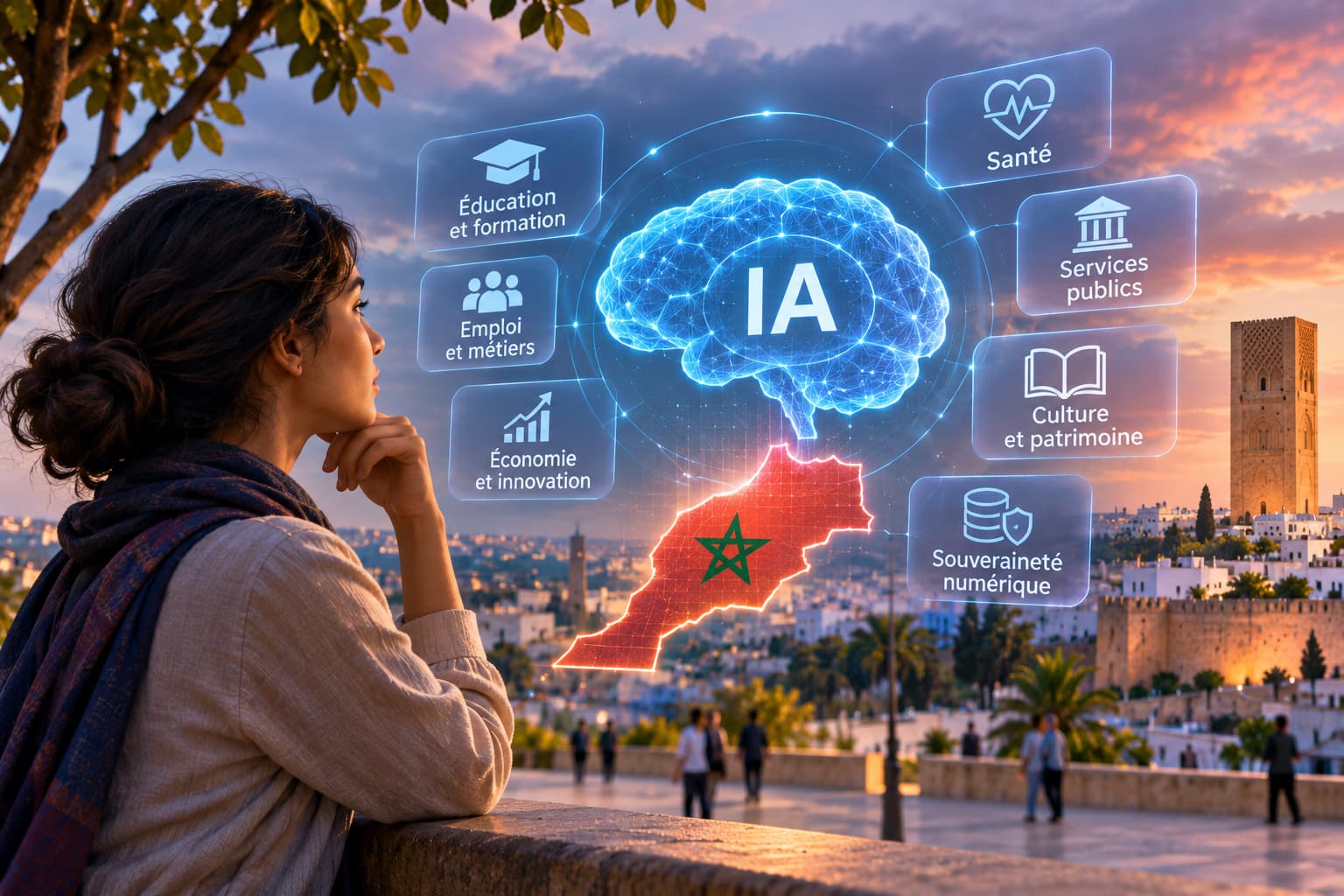
 Artificial intelligence facing the critical crossroads of economy, education, and cultural sovereignty in Morocco.
Economy, employment, education, technological sovereignty, and culture: Morocco facing a revolution reshaping the world.
Artificial intelligence is already reshaping our economies, our professions, our educational systems, and our relationship with knowledge. No nation can now remain on the sidelines of this revolution without running the risk of being subjected to the choices of others.
Morocco appears to have grasped the scale of this challenge. The establishment of a ministry dedicated to Artificial Intelligence, Digital Transition, and Administrative Reform, along with the ambitious goals set for 2030, reflects a genuine determination to claim its place in this new global competition.
The real challenge is not merely to follow the artificial intelligence revolution. It is to ensure it does not take shape without us.
From Ambitions to Concrete Results
Yet declarations alone will not suffice. They must be translated into tangible results: skilled jobs, better-supported scientific research, adapted training programs, competitive companies, and genuinely transformed public services.
The fundamental question is our ability to educate and train the women and men who will drive this transformation forward. For a digital strategy cannot be evaluated by the number of speeches delivered, but by its capacity to improve citizens' daily lives and strengthen the nation's economy.
A technological ambition that generates neither skills, nor jobs, nor added value risks remaining an ambition solely on paper.
School: The Frontline of the Revolution
Education undoubtedly represents one of the most critical frontlines. Artificial intelligence is already disrupting learning methods, access to knowledge, and pedagogical practices.
It is not merely a matter of teaching students how to use new tools. We must empower them to grasp the underlying mechanisms, verify the outputs, recognize their limitations, and sharpen their critical thinking.
At a time when machines can effortlessly produce answers, our utmost priority must be to shape minds capable of asking the right questions.
Sovereignty Goes Far Beyond Technology
Yet there exists an often overlooked dimension of this transformation: cultural and intellectual sovereignty.
Who produces the data consumed and synthesized by artificial intelligence? Who chronicles our history? Who digitizes our archives, our literary works, our languages, and our heritage? Who ensures that our collective memory is woven into the corpus of knowledge accessible to these models?
While exploring Moroccan literature, I questioned several artificial intelligence engines about their familiarity with our authors and their books. That inquiry led me to a realization extending far beyond the literary field: what artificial intelligence knows about us ultimately mirrors what we ourselves have made accessible.
A nation that fails to digitize and preserve its memory leaves to others the privilege of narrating its story.
Digital sovereignty does not merely consist of owning infrastructures or developing software applications. It equally demands preserving, organizing, and ensuring open access to our intellectual, historical, linguistic, and cultural heritage.
A Fundamental Choice for Society
Ultimately, artificial intelligence raises dilemmas that are far from purely technical: the future of work, data privacy, inequalities in access, creative freedom, accountability in automated decision-making, and the place of humanity in an increasingly machine-assisted society.
Morocco must actively engage in these debates and contribute to establishing the governance and standards of this transformation. Waiting for others to engineer the models, dictate the norms, and decide the applications would be an act of abdication.
The real choice is not between accepting or rejecting artificial intelligence. It lies between passively enduring the changes it imposes or taking an active role in shaping them.
Morocco still has a choice. But this window will not remain open indefinitely. In this revolution, time is not a passive parameter: it is already a vital factor of competitiveness and national sovereignty.
The question is no longer whether artificial intelligence will reshape our future—it is already doing so. The true question is what place we intend to claim within it.
To Explore This Reflection Further
Read the complete column and join the discussion on these vital issues on the official blog:
👉 Read on the blog: Artificial Intelligence – Does Morocco Still Have a Choice? →