
Do Our Writers Have Their Place at the University?
Contemporary Moroccan literature deserves more than a place on bookstore shelves: it deserves to nurture the reflection and education of rising generations.
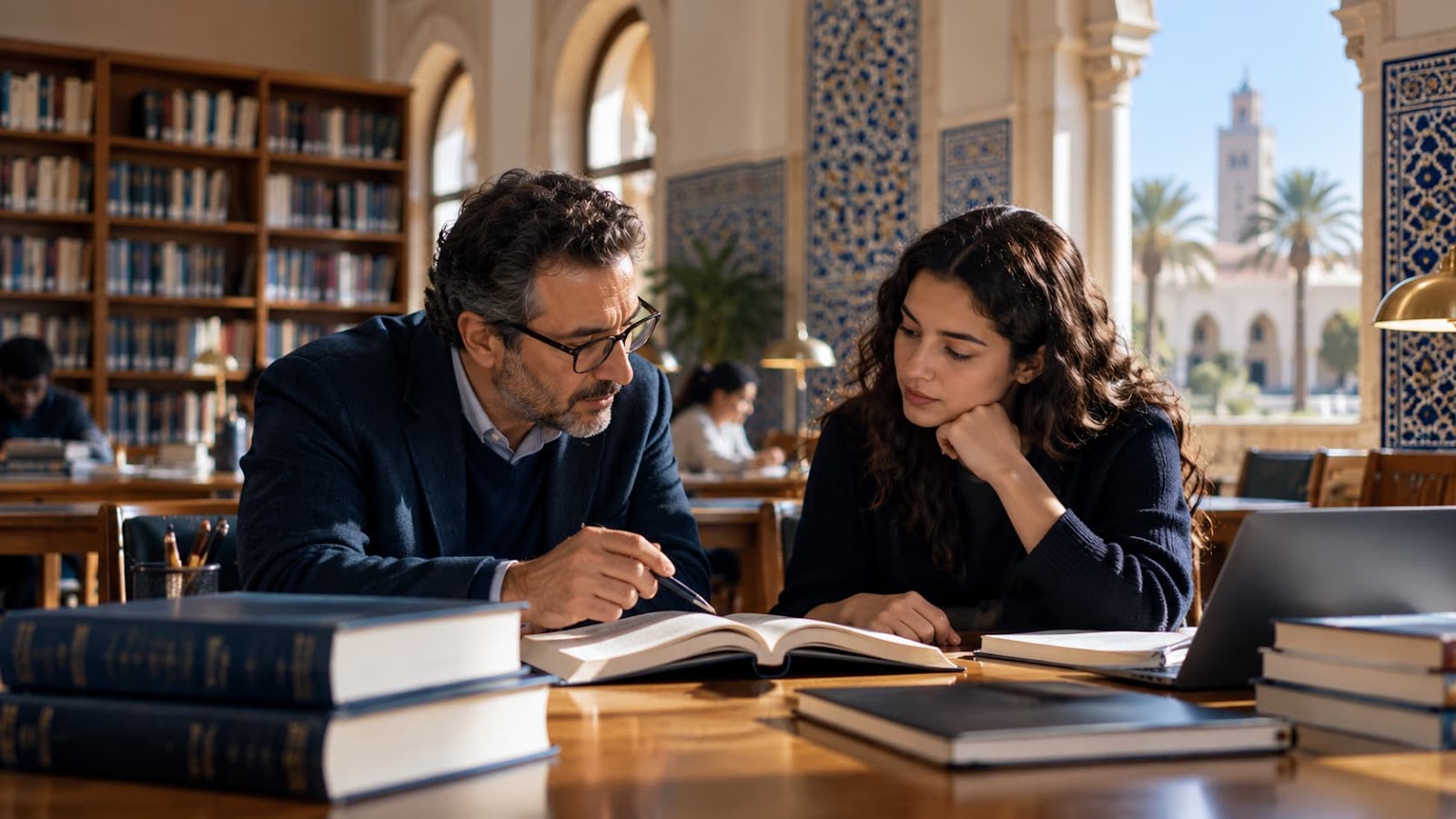 Transmission, academic research, and living memory of contemporary Moroccan literature.
Contemporary Moroccan literature deserves more than a place in bookstores: it deserves to nurture the reflection and education of rising generations.
There is a particular satisfaction for a writer in discovering that an academic has taken an interest in their novel. Not simply because their work receives recognition, but because another perspective comes to extend their own. The book leaves the author's hands to become material for reflection, debate, and sometimes research.
I have previously had the opportunity to experience this with professors and students. The work that Abdelhalim Ziti has recently devoted to my novel At the Gates of the Stars invites me to revisit it. Beyond the personal pleasure of seeing my book studied, a broader question seems worthy of consideration: what place do we grant to contemporary Moroccan writers in our universities?
A Literature That Tells the Story of Our Time
A novel replaces neither a history book nor a sociological study. It possesses its own territory: that of human experience, interiority, and the ambiguities of an era. Through fiction, it reveals subtleties, doubts, and tensions that often escape academic discourse.
Our writers narrate Morocco, its transformations, its wounds, its hopes, and its questionings. They do so in different languages, with sensibilities and imaginations that testify to the profound richness of our culture. Their books are not merely stories meant to entertain: they also constitute a living memory of our time.
Yet this memory must circulate and be transmitted.
It would be unfair to claim that our universities ignore Moroccan literature. Dedicated researchers study these works, specialized journals publish their findings, and academic curricula include literary courses. The real challenge is rather how to give greater visibility to these studies and bring contemporary works into regular contact with students.
We rightly continue to study major classic authors and foundational works of world literature. But should we reserve academic reflection solely for texts sanctioned by time? A living literature is also measured by its capacity to speak to its contemporaries, to provoke reactions, and to spark debate.
A contemporary novel can help students understand their own world, question their certainties, and discover new ways of thinking. Its originality often stems from its tone, its imagination, the uniqueness of its characters, or the manner in which it approaches familiar questions from an unexpected angle.
Studying these works does not mean prematurely conferring upon them a badge of posterity. It means embracing the fact that literature continues to be created before our very eyes.
When a Researcher Encounters a Novel
It is in this spirit that I view the work of Abdelhalim Ziti, researcher at Hassan II University of Casablanca. His study on At the Gates of the Stars examines in particular the representations of individual drama and the fluid dynamics between myth and reality. I also address these themes in a companion article: At the Gates of the Stars: Abdelhalim Ziti's Academic Study.
To go further: An academic reading of At the Gates of the Stars
Abdelhalim Ziti, researcher at Hassan II University of Casablanca, has devoted a study to this novel entitled « Representations of Individual Drama in Rida Lamrini's At the Gates of the Stars: The Flow Between Myth and Reality », published in the International Journal of the Researcher (Revue Internationale du Chercheur).
Prof. Abdelhalim Ziti — Associate Professor, Hassan II University of Casablanca.
To exchange with Professor Abdelhalim Ziti regarding his research work or his study devoted to the novel At the Gates of the Stars, you may contact him directly on his Facebook profile:
What interests me in this approach goes far beyond the personal satisfaction of having my novel analyzed by an academic. The researcher does not merely recount the plot or restate the author's intentions. He delves into the narrative construction, interrogates the characters, examines the underlying symbols, and develops an interpretation entirely his own.
It often happens that an author discovers their own book in a brand new light. We write with intentions, intuitions, sometimes without measuring every implication of what we stage. The critical gaze can unveil correspondences or layers of meaning that we had not perceived in quite that way.
The novel thus continues its journey. It does not remain confined within the vision of its creator; it becomes a shared space of reflection.
This is, in my view, one of the most rewarding contributions of the encounter between creative writing and academic research. The former explores human complexity through storytelling; the latter deepens readings, questions authorial choices, and opens new horizons. Their dialogue enriches both endeavors.
Bridges to Build
I would love to see such encounters become more frequent. That students could work on contemporary Moroccan novels, meet their authors, confront their interpretations, and discover researchers' analyses. That papers published in specialized journals could also reach a broader public through lectures, debates, or accessible publications.
The university naturally does not exist to promote writers. Its critical independence is indispensable: a work must be open to debate, contestation, or even deemed imperfect. But this freedom does not preclude dialogue. On the contrary, it gives it its true value.
Researchers possess the tools to delve deeply into literary works; writers can share their creative experience; educators can transmit these readings and encourage students to forge their own critical judgment. As for students, they discover a literature that speaks directly of the world they inherit and will be called upon to shape.
It is therefore not about forcing every novel onto university syllabi. It is about allowing the most fertile works, regardless of their language or date of publication, to find their rightful place in research, education, and cultural dialogue.
For transmitting a cultural heritage does not consist merely in preserving the monuments of the past. It also means spotlighting today's creations, understanding what they reveal about our society, and providing future generations with the keys to read them in their turn.
A Book Does Not End on Its Last Page
I warmly thank Abdelhalim Ziti for the scholarly work he has devoted to At the Gates of the Stars. His study touches me as an author, but it also delights me for what it represents: the possibility of seeing a contemporary creation become a subject of rigorous inquiry and reflection.
I hope that our universities will take a stronger interest in the contemporary literary creations of our country. Not to multiply tributes to authors, but to circulate their books more broadly, foster critical readings, and bring literature closer to the rising generations.
A novel can move, provoke, surprise, or entertain. It can also stand as testimony to an era, a field of analysis, and an open gateway to questions that students will continue to ponder long after closing the book.
The encounter between Abdelhalim Ziti and At the Gates of the Stars does not alone answer all these questions. It demonstrates, however, what the living dialogue between a writer and a researcher can produce.
What if the university contributed more actively to making our contemporary writers not only the creators of published books, but voices that new generations discover, study, and carry forward with them?