
Why I Write
« Writing has never been a simple stylistic exercise for me. It is a way of inhabiting the world. »
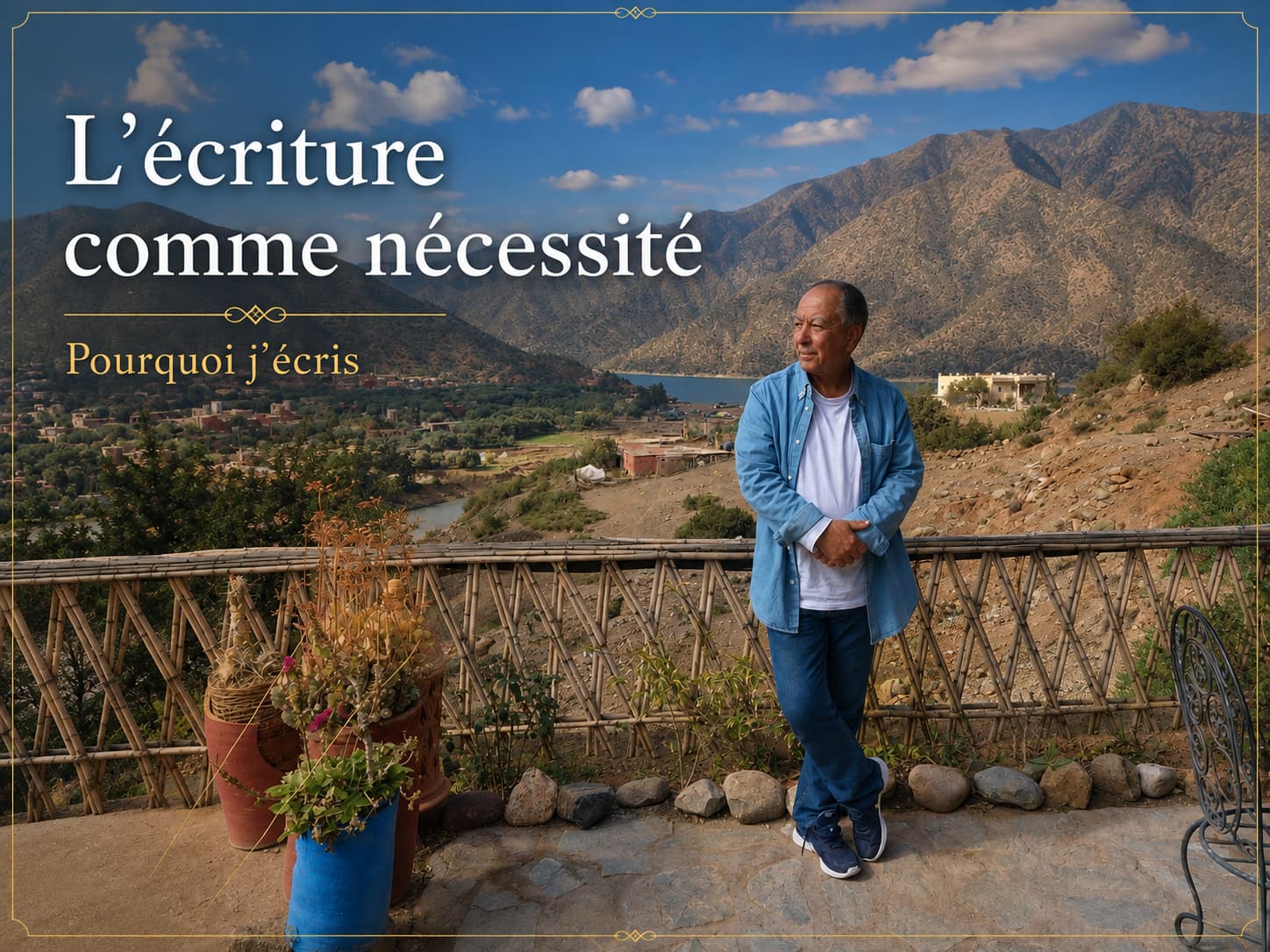
Some pages are not born from daily news. They arise from a need to put into words what deeply animates us. For a long time, people have asked me why I write.
The question seems simple. Yet over the years, I understand that it cannot be confined to a single answer.
Here is the most sincere answer I can offer today.
01. A necessity more than a choice
One never writes for a single reason. One writes because diverse, subterranean forces converge toward the same necessity.
I do not write to add another title to a bookshelf. Nor do I write to entertain a few readers for a few hours.
I write because certain characters, wounds, and hopes continue to live within me and demand a place to breathe.
Long before a novel finds its first word, it already exists differently. Shadows appear, voices return, eyes question, a scene refuses to fade. Nothing is ordered yet, nothing is written. But something insists. As if these characters had invited themselves into my imagination and were waiting for me to finally open the door for them.
Writing means accepting this encounter.
02. Characters before a plot
I almost never start from a plot.
I start from a question. A question that sometimes pursues me for a long time before finding the characters capable of embodying it.
What sets me in motion are human beings: their way of loving, making mistakes, resisting, giving up. Events only interest me through the upheavals they cause. A separation, a disappearance, a secret, a war, or a simple coincidence only become novelistic at the moment they shake a conscience.
The novel is, for me, the place where we can look at human beings with a patience that life does not always grant us.
It allows us to explore what daily life often leaves in the shadows: contradictions, doubts, silences, impossible choices, loyalties that survive time, renunciations that shape an existence. I seek neither to demonstrate an idea nor to deliver a lesson. I prefer to follow a character to the place where they still do not know who they are.
03. The questions that run through my novels
This is undoubtedly why memory occupies such an important place in my books.
We are all heirs of our past. It builds us, sometimes protects us, and also confines us. Some seek to recover what they have lost; others try to escape memories that have become too heavy. Between memory and oblivion lies an essential part of our identity. This territory fascinates me because it is profoundly human.
Love also runs through my novels, not as a promise of eternal happiness, but as an experience that reveals everyone to themselves. It is made of encounters, of course, but also of distance, silence, fidelity, doubt, time that passes and transforms beings. It is in this complexity that I find it most true.
Books are readily classified: psychological novel, thriller, historical novel... I understand this necessity. It helps navigate among thousands of works. Yet, when I write, these boundaries blur.
Suspense interests me when it illuminates characters, not when it accumulates effects. History fascinates me when it meets individual destinies. Emotion touches me when it arises naturally from a human situation. If my novels take several paths, it is always to return to the same question: what makes us who we are?
04. The reader completes the book
I deeply believe that literature does not give answers. It teaches us to see differently.
A novel is not meant to close a reflection, but to open it. It invites the reader to continue the journey with their own memories, their wounds, their questions. Two people never read exactly the same book. Each recognizes something that belongs to them. This is undoubtedly one of the most beautiful powers of literature.
From that moment on, the book ceases to be solely its author's. It becomes its reader's.
The reader sometimes discovers what the writer had not consciously deposited. They illuminate a sentence, give an unexpected meaning to a character, establish links that nothing seemed to announce. The work then continues to grow far from the one who wrote it.
05. A way of inhabiting the world
Writing does not consist in imposing a vision of the world. It is proposing a space where an encounter becomes possible: between a story and a sensitivity, between an imaginary experience and a lived experience, between two beings who may never know each other and who, yet, will share the same emotion for a few hours.
If I continue to write, it is undoubtedly for this.
Because each new novel is a renewed exploration of the human condition. Because no character is exactly like the previous one. Because no essential question is definitively resolved.
And because I remain convinced that literature possesses a singular strength: that of helping us better understand others, while discreetly inviting us to better understand ourselves.
I do not know how many novels I have left to write. I only know that as long as a story comes knocking at my door, I will continue to open it. Because, deep down, writing has never been a simple stylistic exercise for me.
« It is a way of inhabiting the world. »
— Rida Lamrini
If Why I Write explains what pushes me to take up the pen, my reflection continues in the other three foundational texts.
Read on the blog
Find this article in its full version on Rida Lamrini's blog.
📖 Discover the novelistic fresco
Explore the global vision and the presentation of Rida Lamrini's standalone novels.
View The Work and the Catalog →📰 Behind the scenes & reflections on the blog
This reflection regularly continues in the articles published on the blog.
Visit Rida Lamrini's Blog →