
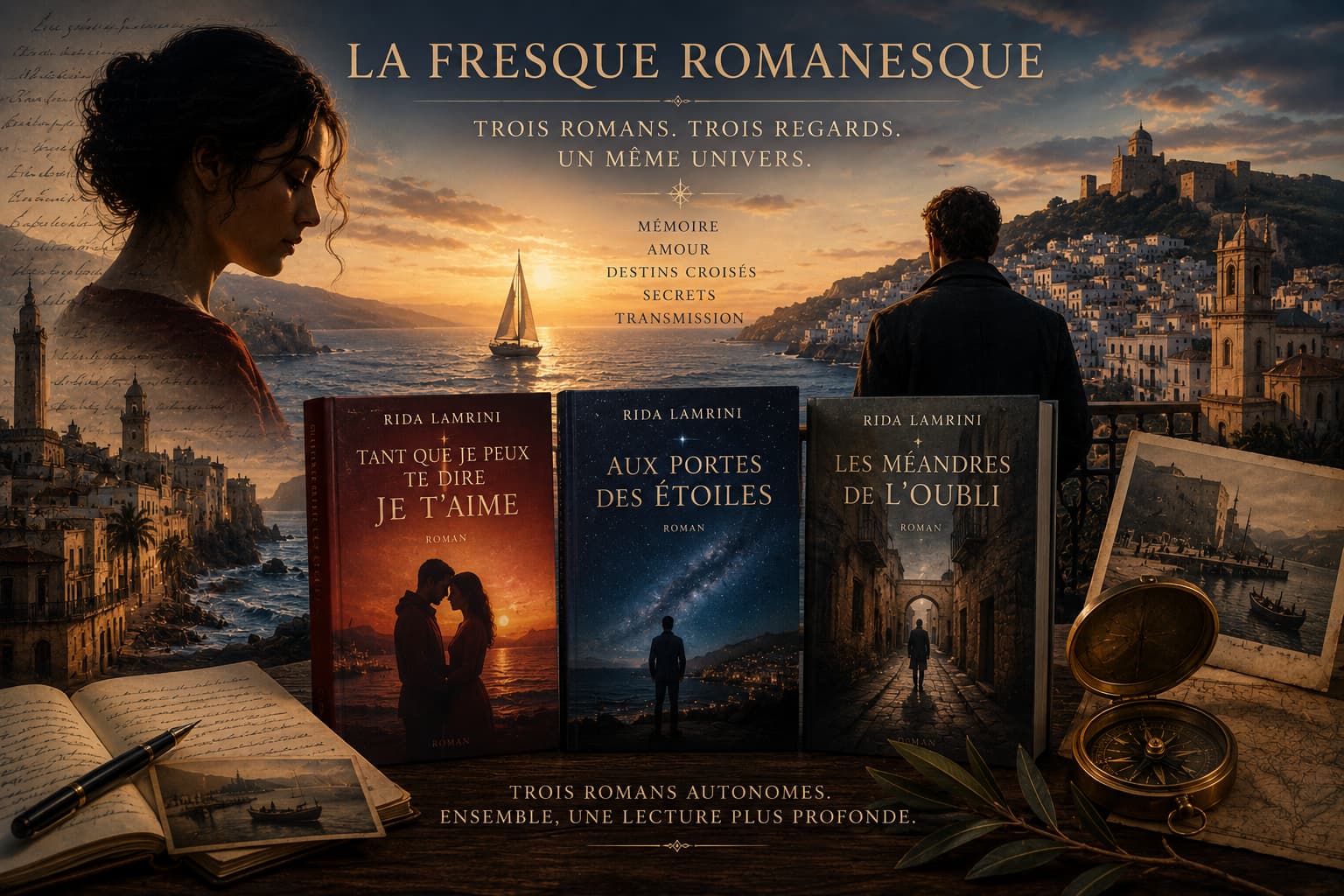
From the father's word to the son's quest, and into the uncertain territories of oblivion, Rida Lamrini's novelistic saga turns filiation into a living architecture and time into a novelistic substance.
1. Beyond the Sociological Novel: The Choice of Form
There is a persistent tendency to confine Francophone Moroccan literature to the reductive role of a sociological document: looking for period testimonies, generational divides, or current affairs observations. While not devoid of interest, this documentary reading sometimes misses the essential: what a novel makes of reality to turn it into literature.
The value of a novel is not measured solely by the reality it documents, but by the transformation that writing inflicts upon it. An oeuvre is an organization of time, a tension of voices, an exploration of the shadows of the human conscience. It is within this exacting standard that Rida Lamrini's novelistic saga belongs (Tant que je peux te dire je t'aime, Aux portes des étoiles, Les Méandres de l'Oubli). Three autonomous books, three narrative registers, but a single backbone: memory and family transmission as principles of literary architecture.
“The value of a novel is not measured solely by the reality it documents, but by the transformation that writing inflicts upon it.”
2. The Inversion of Quests: The Living Principle of the Saga
The strength of this ensemble lies in its refusal of linearity. Rida Lamrini does not offer a conventional family saga where generations obediently succeed one another. He orchestrates a matrix of mirrors and echoes where perspectives are inverted from one book to the next.
In the first volume, a father — Rayan — speaks to recount what he has lived and understood, seeking to pass on to his son the essence of a lifetime before it is too late. It is the time of narration, intimacy, and direct transmission.
Yet the second volume reverses this dynamic: it is no longer the father who transmits, but the son — Salim — who seeks to understand what the father left unsaid. Absence, silence, and shadowed zones become the driving engine of an intimate investigation. Heritage is no longer a gift peacefully received; it turns into an enigma that must be unraveled at the risk of losing oneself.
This inversion is the beating heart of the trilogy. It reveals that family transmission is never a calm river: each generation must reinterpret what it has inherited, even at the cost of contesting its meaning.
“Family transmission is never a calm river: each generation must reinterpret what it has inherited, even at the cost of contesting its meaning.”
3. Three Verbs, Three Movements
The architecture of the saga unfolds through three complementary movements:
The fatherly voice strives to bring order to the past, ward off mortality, and give meaning to the trajectory of a life. It is the affirmation of a memory that intends to remain living and transmissible.
The narrative shifts into investigation and dramatic tension. Salim sets out in search of buried truths, confronting the idealized memory of his father with the unyielding weight of facts.
Memory ceases to be a continuous thread, becoming an uncertain territory. Illness, erasure, and old age disrupt what the first two books had sought to establish. What was thought to be settled slips away.
These three verbs encapsulate the ambition of the oeuvre: not to freeze a family history, but to explore memory in all its states — from its most fervent proclamation to its most vulnerable fading.
4. The Manuscript and the City
Two tangible elements endow this saga with its singular density.
First, the motif of the manuscript. In Tant que je peux te dire je t'aime, writing is both the subject of the book and its vehicle for existence: the text we read is the one Rayan is writing for his son. The novel gazes upon itself as it comes into being, giving the narrative an unsettling intimate resonance.
Second, the presence of Casablanca. The city is neither a picturesque backdrop nor an interchangeable set. It is a full-fledged character: a crucible of destinies, a theater of rises and falls, where individual ambitions cross paths with social inertia. Through its alleyways, the villas of Anfa, and its Atlantic shores, Casablanca stamps its pulse upon the minds of the characters.
“Casablanca is neither a picturesque backdrop nor an interchangeable set: it is a full-fledged character, a crucible of destinies, and a theater of human consciences.”
5. An Adventure of Memory
Ultimately, Rida Lamrini's saga brings an original formal proposition to contemporary Moroccan literature: establishing filiation not as a mere dramatic theme, but as the generative principle of writing itself.
By bridging the father's word, the son's quest, and the twilight of memory, the author reminds us that our identities are never closed. A part of who we are belongs to those who came before us; another, to those who will seek us after our departure.
“A part of who we are belongs to those who came before us; another, to those who will seek us after our departure.”
📚 Discover the Novels of the Saga
Each volume explores a singular dimension of memory and filiation. Explore detailed overviews, excerpts, and ordering options with personalized author dedications.