
The Novelistic Fresco
« Three novels. Three stories. One universe. »
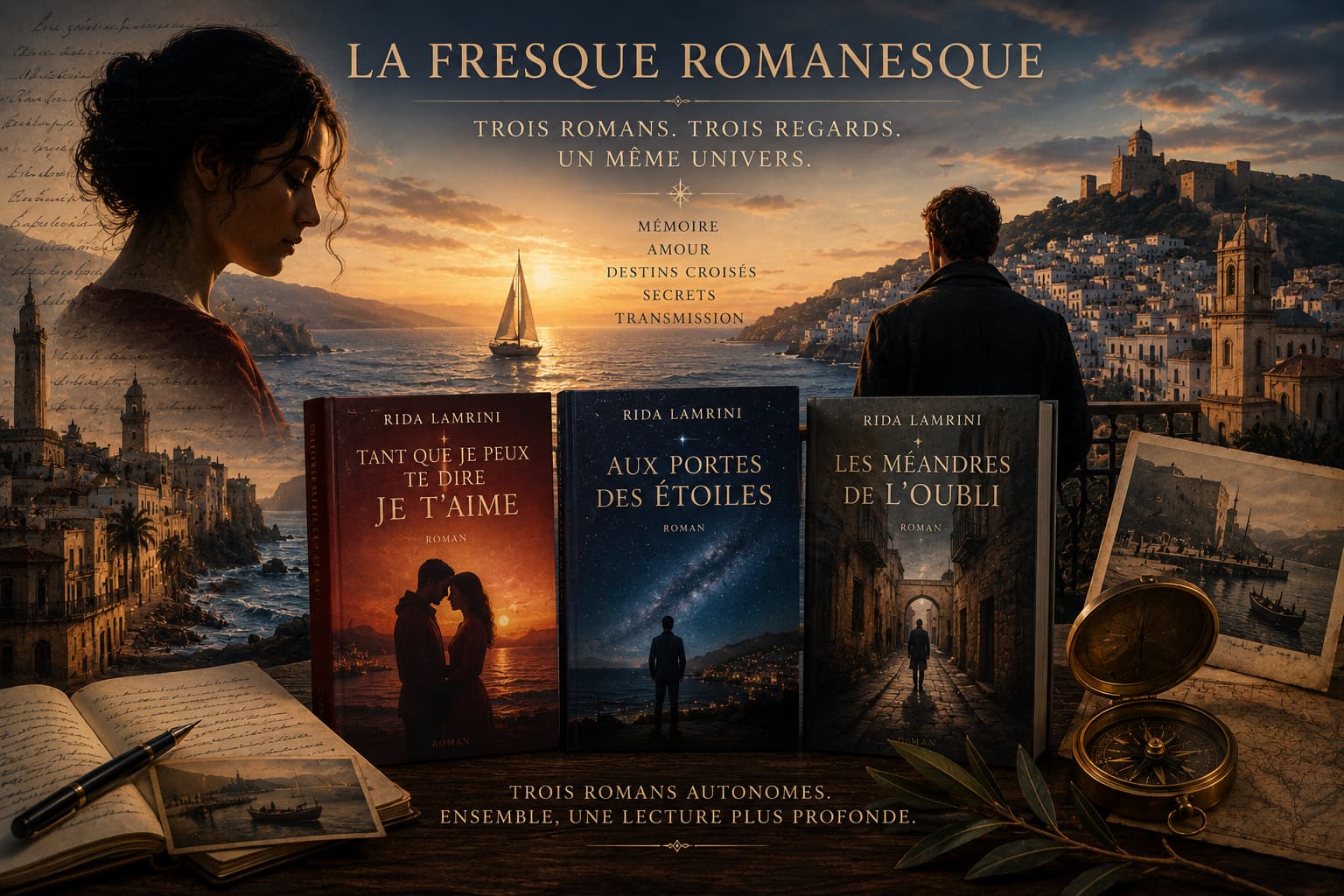
A body of work is not always built according to a fixed plan. Sometimes a first novel naturally calls for a second. Then certain characters continue to live, certain questions remain open, a universe gradually unfolds until it forms a coherent whole.
This is how my novelistic fresco was born.
It brings together As Long as I Can Tell You I Love You, At the Gates of the Stars, and The Meanders of Oblivion.
01. A fresco rather than a trilogy
I speak of a novelistic fresco rather than a trilogy. The distinction matters.
A trilogy often implies a plot divided into three parts, generally read in a fixed order. My approach is different.
Each novel has its own story, its own rhythm, its own main characters and its own resolution. Each can be discovered independently.
The fresco appears when you read them together.
02. Three perspectives on the same human adventure
As Long as I Can Tell You I Love You explores the stirrings of the heart, intimate wounds, and the way an encounter can transform an existence.
With At the Gates of the Stars, the horizon broadens. Individual destinies meet broader stakes. The characters move through a world where History, personal choices, and collective events intertwine.
The Meanders of Oblivion leads this first movement to its fulfilment. Memory, silences, buried truths, and invisible bonds between people hold a central place — without ever abandoning novelistic tension.
Each novel has its own identity. Together, they offer a deeper reading.
03. Echoes rather than repetitions
What connects these three books is not a continuous plot. It is resonance.
Characters reappear. Events take on new meaning. Certain scenes find, hundreds of pages later, an unexpected illumination.
The faithful reader gradually discovers that each novel enriches the ones before it.
The fresco does not repeat. It deepens.
04. A reading on several levels
I wanted to offer two reading experiences.
The first is reading a single novel. The story is complete.
The second is reading the fresco as a whole. The reader then discovers a wider universe, where the connections between characters, places, and themes gradually reveal themselves.
Each reading adds a new depth.
05. A preserved freedom
This construction also allows me to preserve a great freedom of writing. I can change setting, register, era, or tone without losing the guiding thread.
The stories evolve. The characters change. But the great questions remain.
Memory. Transmission. Love. Secrets. The choices that orient a life. The way the past continues to inhabit the present.
06. The beginning of a larger whole
With The Meanders of Oblivion, this first fresco finds its conclusion. Yet it does not close my work. It forms its first great movement.
Other novels will come to explore new territories, new characters, and new forms of suspense. They will not necessarily continue this fresco. They will continue the same way of exploring the human condition.
Because, beyond the plots, one conviction guides each of my books: a body of work is not built by the accumulation of publications, but by the coherence of a universe.
It is this coherence that I seek to build, novel after novel.
« A body of work is not built by the accumulation of publications, but by the coherence of a universe. »
— Rida Lamrini
Read on the blog
Find the full version of this article on Rida Lamrini's blog.
Discover the other three founding texts that make up Rida Lamrini's literary and editorial vision.