When Artificial Intelligence Talks About Moroccan Literature
What five artificial intelligence tools reveal about the awareness and visibility of our writers.
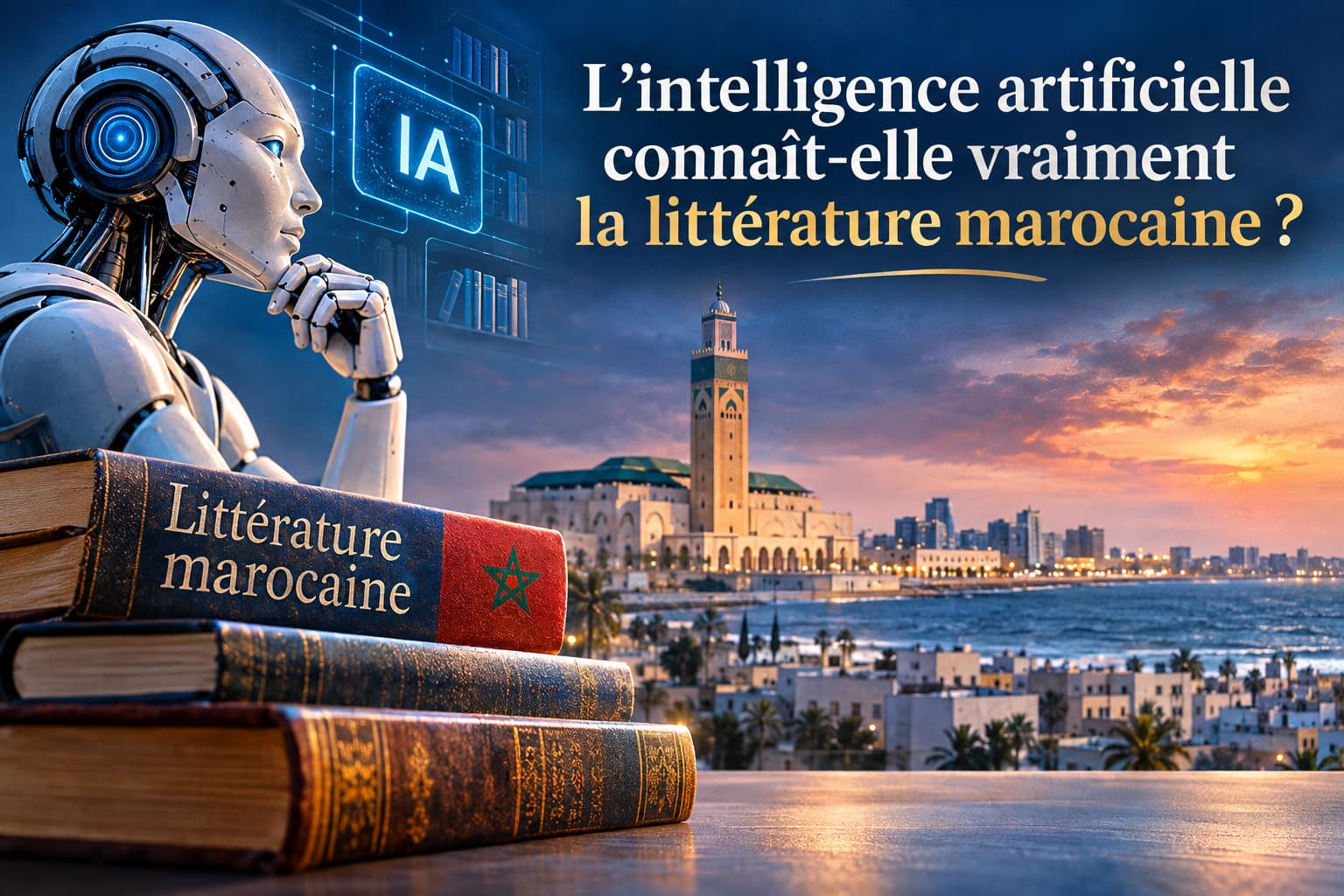 Five artificial intelligence tools facing digital memory and the cultural reach of Moroccan writers.
An Experiment to Question Digital Memory
What place does Moroccan literature hold in the knowledge of artificial intelligence systems? To try to answer this question, I tested five tools: ChatGPT, Gemini, Microsoft Copilot, Perplexity, and Claude.
The objective was simple: to observe what these systems know about our writers, their works, and their presence in the digital space.
An Inquiry Without Names or Titles
On September 21 and 26, 2026, I submitted to these different tools a series of questions focusing in particular on contemporary Francophone Moroccan novelists, themes of memory, filiation, and family relationships, as well as the websites and blogs where writers speak about their work.
One rule was essential: I never mentioned any author names or book titles in my prompts. I wanted to observe what AIs could identify spontaneously from the information available to them alone.
The answers were varied, yet several findings proved particularly revealing. During the second series of tests, all five tools spontaneously cited the same author in response to an open-ended question about contemporary Francophone Moroccan novelists.
These observations remain those of a limited experiment. They constitute neither an exhaustive scientific study nor a ranking of writers’ literary value.
Digital Visibility, a Cultural Issue
This experiment raises a question that goes well beyond the performance of artificial intelligence tools: what do we truly know about our literature when we search for it in digital resources?
A writer’s visibility should not be confused with literary recognition. It also depends on the availability of information about their books, the quality of search indexing, academic studies devoted to them, and their presence in libraries, media, and digital spaces.
This responsibility is collective. Writers, publishers, researchers, translators, journalists, and cultural institutions each have a role to play in passing down our literary heritage.
To Discover the Results of the Experiment
I have published on my blog the detailed account of this inquiry, including the prompts submitted to the five tools and the analysis of their responses.
👉 Read the full article on the blog (in French): When Artificial Intelligence Talks About Moroccan Literature →