
Inhabiting Literature
« Literature seeks neither to convince nor to judge, but to explore. »
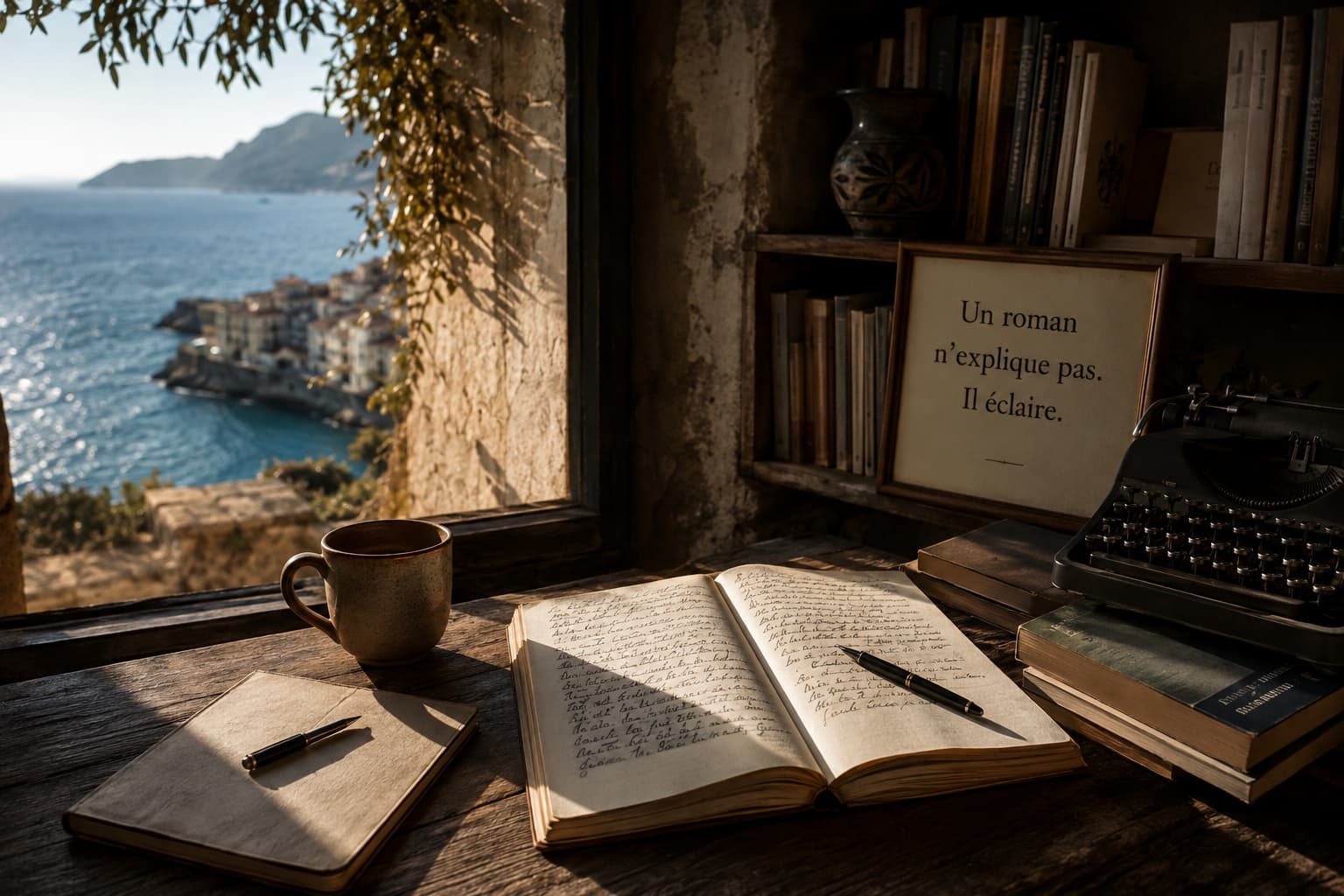
Literature has accompanied humanity for centuries. It has changed forms, languages, mediums, and readers. Yet, its essential function remains: allowing women and men to better understand the world and, perhaps, to better understand themselves.
01. A literature that explores rather than asserts
I do not believe that a novel's mission is to teach a truth. Imposed truths age quickly. Great works, however, continue to question us long after their publication. They do not close questions: they open them.
It is this kind of literature that interests me. A literature that seeks neither to convince nor to judge, but to explore.
Every existence is traversed by contradictions. We are capable of courage and weakness, loyalty and renunciation, generosity and selfishness. No human being can be reduced to a single facet. The novel possesses this precious freedom: to embrace complexity without seeking to simplify it.
When a character comes alive, they quickly escape their author. They cease to be a mere cog in the plot. They acquire their own logic, their hesitations, their flaws, sometimes even a touch of unpredictability. It is often at this moment that writing becomes the most fascinating. The writer no longer advances alone; they accompany fictional beings who, little by little, reveal something of our human condition.
02. The pace of the novel
I love novels that take their time. Those that accept silences, nuances, hesitations. Our era often favors speed, immediate certainties, simple answers. Literature can offer something else: the right to doubt, to slow down, to look differently.
This is perhaps its greatest strength.
A novel does not change the world on its own. However, it can change the way we look at a person, a situation, or ourselves. It invites us to inhabit, for a few hours, a life that is not ours. This discreet experience develops a form of empathy that few other arts allow with such intensity.
03. The memory of places and beings
I also believe that literature is a place of memory.
Individual memories, family histories, historical events, silences passed down from generation to generation nourish the narratives and shape the beings. To write is often to try to understand what remains alive in what we thought was over. It is not seeking refuge in the past, but shedding light on the present.
The Mediterranean holds a special place in my imagination because it embodies this moving memory. For centuries, it has seen the passage of peoples, languages, exiles, encounters, and conflicts. It connects as much as it separates. It reminds us that identities are never fixed: they are built over the course of crossings.
This is why my novels give as much importance to places as to characters. Cities, landscapes, shores, or borders do not merely serve as scenery. They influence destinies. They carry a memory, an atmosphere, sometimes even a secret.
I am wary of novels that claim to explain everything. Life resists definitive explanations. It remains unfinished, contradictory, sometimes mysterious. Literature gains, it seems to me, from respecting this share of the unknown.
04. The reader, partner of the work
Without a reader, a novel remains unfinished.
I do not consider them as the passive recipient of a story, but as its true partner. Every reader brings to a book their personal history, their wounds, their joys, their convictions. Two people will never read exactly the same novel, because they will not seek the same answers in it.
It is this encounter that gives literature all its strength.
When a book is closed, the essential often begins. A sentence returns a few days later. A character reappears in a conversation. A scene suddenly sheds light on a lived experience. The novel then silently continues its journey in the memory of the one who read it.
05. Literature as a dialogue
It is undoubtedly for this reason that I never consider a book as an isolated object.
Around it can arise exchanges, meetings, interviews, chronicles, shared readings, or prolonged reflections. Literature does not stop at the cover of a novel. It continues in the dialogue it opens.
It is also this conviction that nourishes the various initiatives I develop around my books. Whether it is the Face au Texte interviews, radio chronicles, articles published on my blog, or the Beyond the Novels space, all stem from the same idea: a work is only truly completed when it meets readers and opens a dialogue.
Inhabiting literature, therefore, is not only writing. It is accepting to enter this conversation, to listen to the readings of others, to discover what they have seen that the author himself had not perceived, and to acknowledge that a book always continues to be written in the minds of those who read it.
Deep down, perhaps this is what literature is: a dialogue that never ends. And it is in this dialogue that I choose, book after book, to inhabit literature.
« A dialogue that never ends. »
— Rida Lamrini
Read on the blog
Find the full version of this article on Rida Lamrini's blog.
This conception of literature naturally irrigates my other founding texts. Discover them to complete the journey.